Understanding Double Vision: Myasthenia Gravis Insights

Juan Ding, OD, PhD

I recently saw a gentleman in his 70s due to double vision. He started seeing double vision 3 weeks ago at the airport. When he looked out of the window he saw two planes taking off though he knew there was only one. When he covered either eye, the double vision went away. But with both eyes open, he was seeing double images. But this was not happening all the time, only intermittently, and more when he’s tired.

He reported that similar double vision happened 15 years ago briefly, after he took some cold medicine, and it resolved on its own after he discontinued the medicine. 

He did not recall any head or eye injuries. He did not have any other neurological symptoms. He felt well and did walking or cycling regularly. There was no history or family history of autoimmune conditions. He did have type 2 diabetes which was well managed. He had no history of heart disease or cancer. As for new medications, he remembered having covid-19 booster vaccine a month prior to the onset of double vision.

His history clearly indicated that his double vision was because the two eyes were not working together as they should. Many causes can lead to this. Each of our two eyes are controlled by 6 small muscles surrounding the eye (Figure 1). The two sets of corresponding muscles need to work in synchrony in order for the two eyes to look at the same object. If they don’t work in sync, double vision ensues. The first step is to find out which of the eye muscles are at fault. Because these muscles are in turn controlled by different nerves. Finding out which ones do not work will indicate which nerves are not working, and help to find out what is causing the nerve or muscle dysfunction.
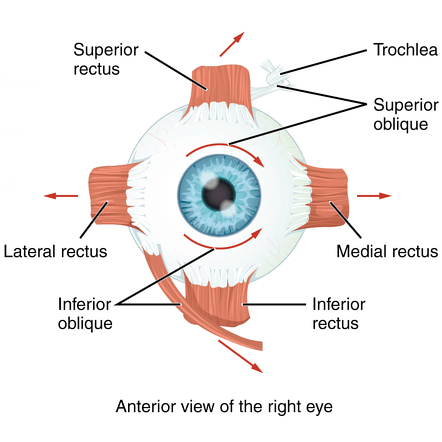
Figure 1. Illustration of eye muscles around the eye, which control how eye moves. Courtesy from Vivid Vision, Inc (https://www.seevividly.com/info/Physiology_of_Vision/The_Brain/Visual_System/Eye_Muscles).

Both of his eyes were able to move in all directions. I then did a careful measurement of his eye alignment, and found that he had a very small vertical misalignment between the two eyes. It was invisible by naked eyes, and only detected by doing an alternate cover test, in which each eye is alternately covered to show a deviation pattern. The result was that the left eye appeared to be slightly higher than the right eye. But it was such a small number and it appeared to be consistent in all directions where he looked. This is what we call a comitant deviation as it shows no difference depending on where a person looks toward. Having a comitant deviation usually indicates the problem has been chronic or benign. Further, the issue is not pinpointed to any specific eye muscle. Rather, multiple muscles may be involved.

The next step is to check if there are any other associated abnormalities. Pupil size differences or reactions to light often are altered in certain nerve disorders. He had normal pupils. Eyelid positions were also often abnormal with some of the nerve problems. His eyelids were symmetrical and both slightly loose and droopy normal at his age.

His vision in each eye was stable, and he just saw another eye provider for a dilated eye exam not long ago with no remarkable pathologies.

So I thought this was a decompensated phoria issue. This means that the person has a slight misalignment between the two eyes and usually well compensated; in certain situations, for example, when tired, stressed, or aged, the compensation reduces and they start seeing double images.

While he was in my office, he was actually not seeing double, indicating a good compensation. Still, since he did frequently see double for several weeks, I offered to try some prism to alleviate the problem. Prism changes the direction of light, and can therefore allow two eyes see the same image if light direction is altered just matching the misalignment. He felt seeing things more clear and comfortable with 1 unit of prism. Interestingly, he felt comfortable and clear with up to 5 units of prism before he complained of seeing double at 6 units. This type of a relatively large range of fusion often indicates a congenital misalignment. The most common being congenital cranial nerve 4 palsy. However, this did not appear to be what he had, as he had no head tilt now or in his driver’s license photo, and the comitancy of the misalignment that we discussed earlier also did not fit.

This was not a typical case. It was not likely from a brain etiology, but some of the mimickers that can cause double vision should be ruled out. So I ordered blood tests for myasthenia gravis and thyroid eye disease. I prescribed prism glasses and asked him to follow up in a few weeks.

To my surprise, a few days later, his blood test was positive for myasthenia gravis (MG), an autoimmune condition that weakens the communication between nerves and the muscles they control. I immediately referred him to a neurologist, the speciality that diagnoses and treats this condition. 

The neurologist concluded that he had the ocular MG, which affects only eye muscles. However, with time many patients with ocular MG may convert to generalized MG, with muscle weakness affecting other organs of the body. The most serious would be the muscles for swallowing and breathing, as they may develop difficulty breathing, which can be life-threatening. Further, a subset of MG patients also have a tumor in their chest, called a thymoma, and 30% of these tumors are malignant. So my patient is going to have a chest CT very soon.

I saw him again for follow up and he reported seeing well with the new glasses and did not have double vision any more. With ocular MG, the double vision could change pattern over time so we would monitor this regularly. Given that he had no other symptoms, no additional treatment was necessary at this time and he was also being monitored by the neurologist regularly.

My patient does not require additional treatment besides prism at the moment, but if his symptoms change, additional treatment may be necessary. For example, medications such as pyridostigmine, oral steroids, immunosuppressive agents, intravenous immunoglobulins (IVIG), and biologics. When difficulty breathing develops, patients should go to emergency room to have prompt IVIG treatment as it can be life-threatening.

MG can present in the eyes first. In fact, almost 50% of MG present as ocular MG [1]. But up to 60% will eventually convert into generalized MG [1]. One classical feature of ocular MG is the incomitancy of double vision, which we discussed above. This means that double vision or the misalignment of the two eyes is different depending on which direction the person looks at. As you recall, my patient had comitant deviation, which was why it surprised me that he tested positive for MG in the blood test. However, it’s a relief to find in literature that 25% of ocular MG were reported having comitance or change of comitance to incomitance or vice versa [1]. Further, another classical presentation of ocular MG is ptosis, or droopy eyelid, which my patient also did not have. MG diagnosis is often delayed in cases where there is only double vision and not ptosis.

Another interesting observation is that there were multiple reports of new onset MG shortly after covid-19 infection or vaccination [1]. However, a causal relationship was not well established. I did not think twice about his covid booster, but seeing that this is observed in the scientific community, I will probably ask about covid infection of vaccination in future suspected MG patients. 

Lesson learned is that even an atypical case of double vision could be MG. Having no ptosis does not mean it cannot be MG. Being comitant in double vision does not mean it’s not MG. Don’t ever forget to rule this condition out.

For more information, please refer to this excellent review article [1]. Direct references and much more information about ocular MG can be found in there.

Review article cited:

[1] Behbehani R. Ocular Myasthenia Gravis: A Current Overview. Eye Brain. 2023 Feb 5;15:1-13. doi: 10.2147/EB.S389629. PMID: 36778719; PMCID: PMC9911903.

Skin Rash and Eye Health: Link to Uveitis Revealed

Juan Ding, OD, PhD

I look at eyes all day, and have to admit that I care less about anything else. But this case was a big help from another specialty which not only nailed the diagnosis but also saved a lot of $$$ and time on the expensive and lengthy tests that we so often have in the health care.

Case: visiting the eye doctor

A man in his mid 50s, Edward, we will call him, came into the office complaining about new floaters in the left eye for 1 week. This is a very common complaint, which I hear about almost daily.

If you read my previous posts, you would know that the most common cause of floaters are vitreous degeneration or detachment (link and also here) and the biggest worry would be that there was a retinal tear or detachment in the process (Refer to Figure 1 below for these structures: vitreous and retina).

He saw no flashes, and there was no injury to the eyes or the head. He had no pain and no visual changes.

The exam showed normal vision, normal eye pressure, and interestingly no vitreous detachment. However, there were some cells in the vitreous in the left eye (again refer to Figure 1 to see where the vitreous is in the eye). The retina appeared normal without any tear or detachment. A closer looked showed that there were even cells in anterior chamber, the front chamber of the eye (in contrast, the vitreous is the back chamber of the eye). 

Figure 1. The vitreous is a large space filled with a jelly inside the eye. In Edward’s case, this jelly now contains many inflammatory cells causing him to see floaters. Image from National Eye Institute [1].

So this was a form of uveitis, which is less common, but also can cause floaters, which I talked about in a previous case also (link). 

Uveitis is the inflammation of the colored layer of the eye, called uvea (Figure 1). Injuries can cause this inflammation, but so can infections, autoimmune diseases, cancer and sometimes no reason that we can find.

The question is, what is causing the uveitis?

More about this patient

I asked him if there was anything else going on besides the eyes? 

He said, ‘I have had a skin rash on my back before the floaters showed up. My dermatologist gave me a fungal cream but it’s not working and I am going back to see him next week.’

Otherwise he was in his usual health with no complaints.

Looking at his other office visits, I could see that he fought two cancers, once 10 years ago and once 5 years ago. Fortunately both were found in stage 1 and adequately treated.

He was HIV positive, but had normal CD4 values and was taking his anti-virals consistently. He was also being tested regularly on chlamydia and syphilis and negative in these in the last labs 4 months ago.

Based on this history, cancer is a concern. But HIV related etiologies are also possible. These both can cause uveitis. Further, inflammatory causes (non-cancer, non-infectious) are also possible. 

Cause of uveitis revealed by skin test

I promptly referred him to our uveitis specialist, who will run a battery of tests and imaging to figure out what is the cause.

However, it was his dermatologist that nailed the diagnosis and sent him for the definitive treatment.

Since the rash did not improve with medical treatment, his dermatologist performed a skin biopsy, which showed a very small bug (called spirochetes), the causative agent for the rash, and also the uveitis in the eye. These spirochetes are the microorganisms that cause syphilis, a sexually-transmitted disease that is sometimes found to be more prevalent in those with positive HIV. 

In this case, a simple skin biopsy saved him the trouble of a battery of tests and imaging procedures, which was the silver lining of his unfortunate symptoms. The treatment, IV penicillin, is usually quite effective.

Additional thoughts

In the end, this outcome might be the best it can be. Cancer in the eye, such as lymphoma, would be much more difficult to get rid of, not to mention possibility of death.

As an eye doctor, the most important thing is not to mis-diagnose this special form of uveitis as the good old vitreous detachment, even though vitreous degeneration or detachment is the horse, and uveitis is the zebra.

And syphilis, a great mimicker of all forms of uveitis, should always be tested, especially if the patient is at risk.

So if you have new floaters, please reach out to an eye doctor, because your retina may be at risk and it could be something else.

Learn more about uveitis from this reference below.

Reference

[1] Uveitis, National Eye Institute, https://www.nei.nih.gov/learn-about-eye-health/eye-conditions-and-diseases/uveitis

Hemianopsia Unveiled: The Intriguing Case of Blurry Vision and the Hidden Tumor

Juan Ding, OD, PhD

I saw a woman in her late 60s 3 months ago. She had moderate cataract and dry eye, and I recommended some basic treatments of dry eye and asked to see her again in 3 months to check if the dry eye responds to treatment.

So now she’s back again, her dry eye remained about the same despite doing what I told her. I now prescribed a medication eye drop to use twice daily in addition to the basic dry eye regimen. 

At the end of the visit, she asked me something else. ‘My vision is blurry on the left side compared to the right side, when I am reading or looking at people’s faces. This has been going on for a month now.’

This triggered a red flag, as the way she described it, it indicated that both eyes are seeing blurry on one side vs the other, and that would be brain thing, not an eye thing.

I immediately did a confrontational visual field, which entailed asking her how many fingers I was holding up in either side of her peripheral vision. This was however inconclusive, because she was hesitant but answered correctly for both sides. 

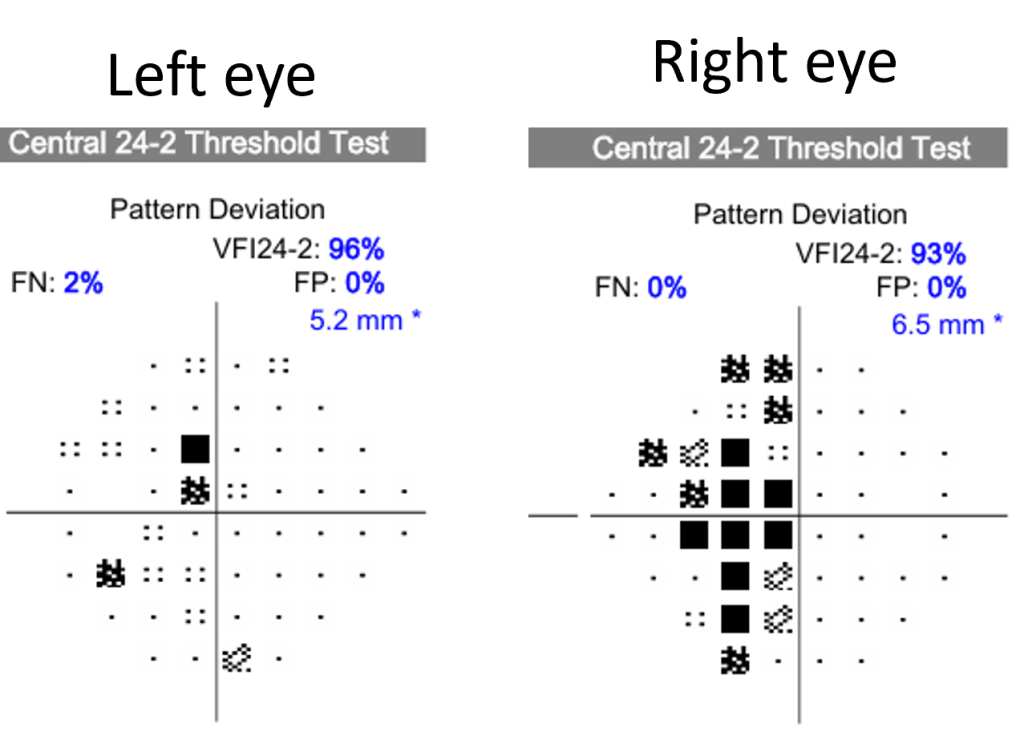
So I ordered a formal visual field testing, called Humphery Visual field test 24-2. This is a much more sensitive test than counting fingers and can quantify the sensitivity of peripheral vision in a given field of view. Fifteen minutes later, it showed results as below.

Figure 1. Visual field testing of each eye individually showing a left-sided defect in the right eye, and a mild defect in the left eye.

You can see that the right eye has a dark area on the left side, and the left eye also, but to a much less extent. What is unique about this visual field is that the dark area is only a relative defect, meaning she could still see fairly well, only less well compared to the right side. That is why she was able to tell the number of fingers in both right and left sides. But this also is consistent with her complaint, she’s not saying that she could not see one side of the face or a book, but just that one side was more blurry. 

This could still be a hemianopsia, like I talked about in a previous article, in which the other patient had a stroke. 

So immediately I needed to rule out that she had a stroke. 

She denied almost all of the stroke symptoms I asked about her, including headache, double vision, numbness or weakness. She appeared well and healthy, with no acute distress. She had high blood pressure, and was taking medications for it. She did not have diabetes or high cholesterols. Further, her symptom of one-sided blurry vision had been going on for 1 month already, so in all, this was unlikely to be a stroke.  

So I did not need to send her to ED, but my job was not done yet. We still needed to figure out why she was developing the symptom. So I asked her to follow up with her PCP to investigate this. I faxed her record to her PCP and asked her to call her PCP if she did not hear from her that week.

Still feeling uneasy, I kept thinking about her. The visual field was suggestive, but the left eye was so mild, and it’s actually not quite reliable, you could almost say this result should not count. And if you only have a defect in one eye, that would not be a hemianopsia. That would be an eye thing, and not a brain thing. Yet with all the reasoning, I couldn’t help feeling worried, because she was very specific, clear and accurate in describing her symptoms, which showed up exactly in the test.

Something is not right. Next day, I ordered a brain MRI with and without contrast, which initially I wanted to defer to the PCP, together with other tests.

Less than 2 weeks later, a letter with red flag arrived in my inbox. I opened it up and saw her name. Her brain MRI was out. As I scrolled down the radiology report, one glimpse of the work ‘a large mass’ was enough to give me the chills. My biggest worry turned out to be real. She had a large meningioma that compressed onto the occipital lobe, which caused her visual symptom. 

Action was taken quickly. She had whole body scan and fortunately no tumor was found anywhere else in the body. A week later, she had surgery to have the tumor removed and now she’s in recovery.

Most meningiomas do not spread to other parts of the body, as is her case (at least so far as we know), and successful surgery can lead to a good prognosis.

I hope she gets well soon, and hope to see her doing better with her vision in 2 months at her scheduled eye exam visit.

In addition to stroke, brain tumor is also a common cause of hemianopsia. In contrast to a stroke, a tumor may cause symptoms gradually and slowly, as the growth of the tumor can be a process, rather than in a stroke where a blood supply is suddenly cut off. Therefore symptoms that are more slow in onset and sometimes even vague should raise suspicion of a tumor.

Small clues may unravel large tumors, be on the alert for small clues. 

Losing half of vision is no small matter

Juan Ding, OD, PhD

Today I will tell the story of a patient who lost half of his vision. 

Disclaimer: patient’s name is an alias, but the case is real.

I saw John once a year for a few years, monitoring his glaucoma suspicion. Glaucoma suspicion simply means that one’s suspected to have, but does not really have glaucoma yet. He had good vision in general, but usually had many complaints about his vision, mostly that he had to use glasses which he never needed to wear before. 

Once he splashed some chemicals in his right eye while doing house work, and saw my colleagues multiple times while I was on vacation. According to the medical record, the chemical burn had resolved. He came to see me shortly after that.  

‘Doc, I cannot see with my right eye’. My thought was, maybe he was having scars on the cornea. But his cornea looked clear with only a faint scar in the periphery that could not cause vision loss. What’s also interesting was that both his eyes had similar vision. But he insisted that since the chemical splash, he could not see well in the right eye. Could the chemical have reached the back of the eye and caused retinal or optic nerve damage? With a dilated exam, as well as photos of the optic nerve, everything still looked as good as before. There was no apparent retinal or nerve damage.

So I ordered a visual field test. This test examines the periphery vision rather than central vision. I have a couple of his results from previous glaucoma testing, and one looked like Figure 1 A. The dark spots mean vision is less sensitive in that region. So in this graph (Figure 1A), there are only a few minor defects in both eyes.

Figure 1. Gray scale graphs representing visual field results. Each eye was tested separately and darker the spot means worse vision in that particular region. Copyright: Boston Eye Blink

When I saw his visual field results on that day (Figure 1B), I knew the worst had happened. I immediately called him and said, ‘John, you have to go to the emergency room right now.’ 

 As you can see now he had lost a half of vision on the right side, both for right and left eyes. So while he was complaining of not seeing in the right eye, he was actually not seeing on the right side.

This is called a hemianopsia, which means ‘half no see’, or losing vision in one half of the visual field. Vision with hemianopsia is somewhat depicted in Figure 2. This is not an eye problem. This is a brain problem. Specifically, there is a problem in the left side of the occipital cortex, a part of the brain that gets signals from the eye. 

Figure 2. Simulation of vision with right-sided hemianopsia. Everything to the right side of the visual field appears gray out or dark.

You see, our eyes ‘see’ things, but it’s really the brain that perceives the action of ‘seeing’ and gives meaning to it. When the brain suffers damage, both eyes will lose vision on the same side. But often patients will perceive the right side of vision loss as vision loss in the right eye.

And one of the most common causes of such brain damage is a stroke. Especially in a patient like John who has high blood pressure and heart problems. John had a history of congestive heart failure and had a pacemaker. 

‘But I am not having a stroke. I feel fine.’ John said. I asked for several other symptoms, such as weakness or numbness on one side of the body, slurred speech, difficulty walking, and so on. He denied all of it. 

He had been to the ED before, it was not a pleasant experience. He sometimes waited for 8 hours and just left before being seen. 

I get that. But this time it is different. Hemianopsia can be the only symptom of a stroke. I managed to convince him to go that day. I also called his PCP to check up on him to manage his high blood pressure.

In the subsequent weeks, he developed other stroke symptoms including weakness in his leg. 

I saw John again after 2 months. Needless to say, John was very distressed about his vision problem. He’s bumping into things and felt unsafe to drive. He complained about the long wait in the ED. The head CT scan did not reveal much, but he could not do the MRI due to his pacemaker. His visual field looked like in Figure 1C above. Well, not much improvement, perhaps a little worse even. 

Research has shown that many stroke patients suffering hemianopsia recover partial or full vision within 6 weeks. He’s clearly not in the lucky team. If they don’t show any improvement by 6 months, it’s unlikely they will ever have improvement. About ⅓ of all stroke patients with hemianopsia will never recover or improve. I have seen some patients just like that, they permanently lose half of their visual field after a stroke.

I asked John to come back in 4 months, which will be 6 months post stroke, to check again.

This time his visual field looks like above (Figure 1D). It looked like he had a full recovery! I was relieved and felt very happy for him. I asked him, ‘how do you feel about your vision?’ I was surprised to hear him say, ‘Terrible. It’s getting worse.’ 

‘How come? Your visual field is much better. You are basically normal now.’

‘Oh THAT,’ he said, ‘yes that’s better, I can drive again. But my glasses are broken and I really cannot see anything for reading.’

You will be happy to learn that John now has new glasses and is seeing well. He’s seeing his PCP as well as his cardiologist to manage his high blood pressure. 

Crocodile tears

A man in his 30s came in because he saw flashes of light for 20 minutes two days ago.

He was having very blurry vision and could not focus as well at the time, but it all resolved on its own and he remained symptom-free. After a thorough dilated exam I determined that his retinas were completely normal and his symptoms were most likely from ocular migraine. 

Then he brought up something else completely unrelated. For three years now whenever he ate something his right eye would tear up and it’s always only the right eye. That eye was not red, itchy or painful, it simply teared up a bit. 

He did not have dry eye. And both of his eyes were white and quiet with no sign of tearing at the time. His description sounded almost like crocodile tear syndrome. This is a very rare condition where the nerve that supplies the salivary gland somehow also goes to innovate the lacrimal gland which secretes tears. When he’s having a meal his salivary gland gets a signal to start secreting saliva, and that cross talks to his lacrimal gland which makes his right eye tear up. This often happens after nerve injury when the nerve tries to repair itself and makes an inadvertent mistake. This is called aberrant nerve regeneration. But he denies any facial or head injury. He reports to be completely healthy and taking no medication. 

The treatment for crocodile tear syndrome is to inject Botox into the lacrimal gland so that a part of the gland doesn’t work and therefore not too many tears are produced. In his case this doesn’t really bother him so we will just monitor.

Fake membrane

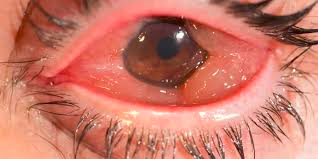
A man in his late 40s came in with blood shot and swollen eyes. 5 days ago while in the gym he rubbed his eyes after cleansers still on his hands. Since then each day both of his eyes were feeling worse with foreign body sensation, itchiness, pain and discharge. He went to urgent care 2 days ago, was given antibiotic drops and ointment, but felt it’s not helping. His conjunctiva (white part of eyes) were the most swollen that I had seen. Unfortunately I did not take a photo, but found one on the internet that quite resembled his eyes at the time as shown below.

Image 1. Conjunctiva chemosis (swollen conjunctiva). Image from https://images.app.goo.gl/V48FJXf32i9gdeov5

Cornea (black part of the eye) was clear. At the time I thought this was toxic/allergic conjunctivitis, so prescribed a steroid drop to use 4 times a day for 7 days. 

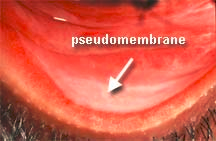
A week later, he came back, reporting improved symptoms (pain 3/10 from 5/10 previously), but still lots of discharge. This time, the swelling was gone, the redness almost resolved, but when I pulled his eyelid down, there were white pseudomembranes (fake membranes) in both eyes, more in one eye than the other. Below is again from internet, showing similar to what I saw.

Image 2. Conjunctival pseudomembrane, a white membrane developing inside the eyelid. Image from https://images.app.goo.gl/bUz4K3c7xtfaDYaYA

Now this made me rethink the diagnosis. Pseudomembranes are often seen in infectious conjunctivitis caused by nasty bugs such as Corynebacterium diphtheriae, Neisseria gonorrhoeae, Streptococcus pyogenes and adenoviruses, some of these are highly contagious. I asked whether anyone else in the household developed pink eyes, and he said no. He had no systemic symptoms or swollen lymph nodes, which were a good sign. Pseudomembranes can also be caused by toxic and allergic agents, and even foreign bodies [reference 1]. So at this point I was still going with allergic conjunctivitis, but these other infectious causes were now on the back of my mind, making me uneasy. So I stopped the steroid drops and switched to an antibiotic/steroid combo drop, as well as adding an antibiotic ointment at night. Of course, the pseudomembrane had to be removed otherwise he would not get better.

1 week later he came back, this time he’s much better, no discomfort, not much discharge, no swelling or redness. Exam revealed residual tiny papillae, and the membranes were gone! 

To summarize, pseudomembranes can be caused by infections, toxins, foreign bodies or allergies, and to treat it the underlying cause needs to be addressed, and pseudomembranes need to be removed promptly.

Reference:

[1] Ho D, Lim S, Kim Teck Y. Pseudomembranous Conjunctivitis: A Possible Conjunctival Foreign Body Aetiology. Cureus. 2020;12(5):e8176. Published 2020 May 18. doi:10.7759/cureus.8176

Gray floater in an elderly lady

Floaters can be so common, yet not all floaters are the same. Here is another example.

An 84 year old nice lady came for an urgent visit as she started noticing a greenish gray floater in the right eye for 1 week. She did not notice any flashes. Her right eye saw 20/400 with no improvement with pinhole (this usually means that vision cannot be improved with glasses). Her left eye was able to see 20/30.

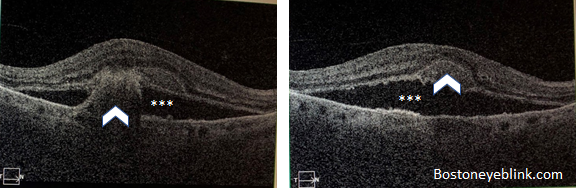
It’s impressive that she had not had cataract surgery yet, and only had a moderate amount of cataract. One look at her macula in the right eye revealed why she saw this gray ‘floater’. There is a blob of blood there as shown in images below. 

Figure 1. New membrane (arrow head) and bleeding (***) in the macula of the right eye.

The other eye only had mild drusens in the macula, indicating early age-related macular degeneration.

So this may be a case of very asymmetrical presentation of AMD with the right eye affected by wet AMD with acute bleeding and vision loss, and left eye only affected by mild dry AMD.

I referred her to a retinal specialist for treatment.

See my other articles on “floaters” and related eye phenomena.

Annoying floaters, where do they come from? And what should you do about them?

Floaters in a young woman

Where is the pit?

Juan Ding, OD, PhD

Our central vision is seen by a structure called macula in the retina, and the center of the macula is called a fovea. Normally there is a pit dipping down at fovea as shown in Figure 1 below, and this is important for normal central vision.

Figure 1. Normal foveal pit indicated by the arrow.

Yesterday I saw a kid that had abnormal, or under-developed fovea.

This 6 year old boy came with his foster mother. He had fair skin, blond hair and was very light-sensitive. Mom never noticed anything abnormal, but he failed the vision test at his pediatrician’s office and that’s why they came here. 

His vision was 20/50 and 20/40, normal eye alignment, minimum refractive error, but after cycloplegia about +4.00 of hyperopia. At any rate, this hyperopia should not cause reduced vision at his age. So what can it be?

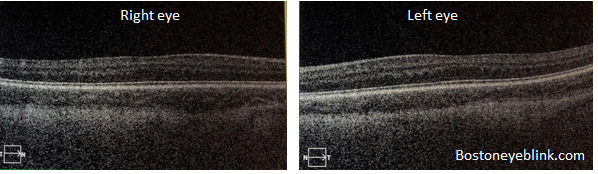
Interestingly when I looked at his retina I could not see a foveal reflex. And the retina was really light in terms of pigment. I attempted OCT and with some luck, managed to get photos from this well-behaved 6 year-old. It is apparent that his macula is lacking a normal foveal pit (Figure 2, right and left eye, respectively). 

Figure 2. Lack of a foveal pit in right and left retinas in our patient.

I gave this a tentative diagnosis of ‘fovea hypoplasia’. This condition can be seen in ocular albinism (lack of melanin) or aniridia (lack of iris), or it can happen as an isolated condition. He has normal eye structures everywhere else. Combined with a blonde fundus and extremely fair skin, I do suspect albinism. But he has no nystagmus, and vision is very good if he does have albinism. Since he was adopted, we do not know much about his family history. Mom adopted him while he was 18 months, and noted good health and normal developmental milestones up to now.

Given moderate to high hyperopia, I gave him a prescription of reading glasses. I referred him to his pediatrician to consider genetic testing.

Keratoconus

Juan Ding, OD, PhD

This case is from one of my favorite patients. He first came to me as a referral from his ENT (ear, nose and throat) doctor, because he complained about dry eyes since his facial nerve palsy on the right side. His ENT doctor was not the one to diagnose facial nerve palsy of course, but since he was undergoing several sinus surgeries he happened to mention this during one of the visits. 

In his initial eye visit, I noticed that his vision was not able to be corrected to 20/20 by glasses, and he had a large amount of astigmatism. Retinoscopy showed scissor shaped light reflex, and slit lamp exam showed steepening cornea with prominent nerves and the right cornea actually had a mild scar. Corneal topography later confirmed keratoconus in both eyes, more so in the right eye.

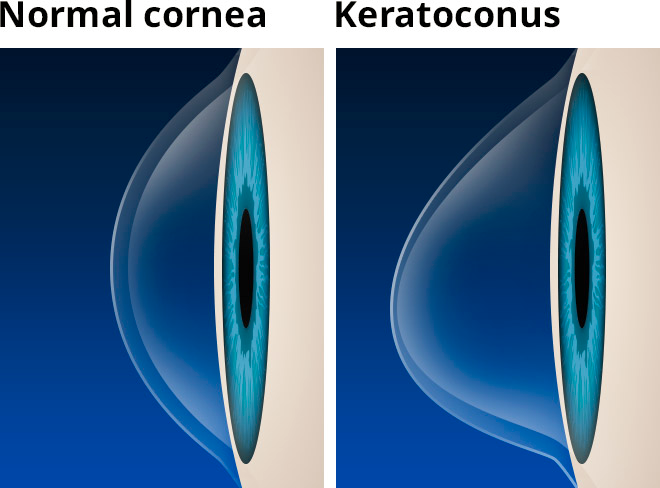
Keratoconus literally means a corneal cone. Cornea is the front transparent layer of our eyes, and it is usually a regularly shaped dome like in the image on the left (Figure 1). But in keratoconus, the cornea gradually becomes thinner and thinner, and bulging more and more like in the image on the right. Because now the cornea is irregular, vision is blurry, even with glasses often still not good, since glasses do not correct this irregular surface of the cornea. Even regular soft contact lenses will not do much in this case because the soft lens material will just drape over the irregular cornea and still showing the irregular optics.

Figure 1. Normal cornea and cornea with keratoconus. Image from www.allaboutvision.com

Fortunately certain rigid contact lenses called rigid gas permeable (RGP) lenses can correct vision. These are stiff and can mask the irregularity of a keratoconus cornea. These are typically small, and often very uncomfortable especially in the beginning while the hard lens rubs against the surface of the eye and the eyelid.

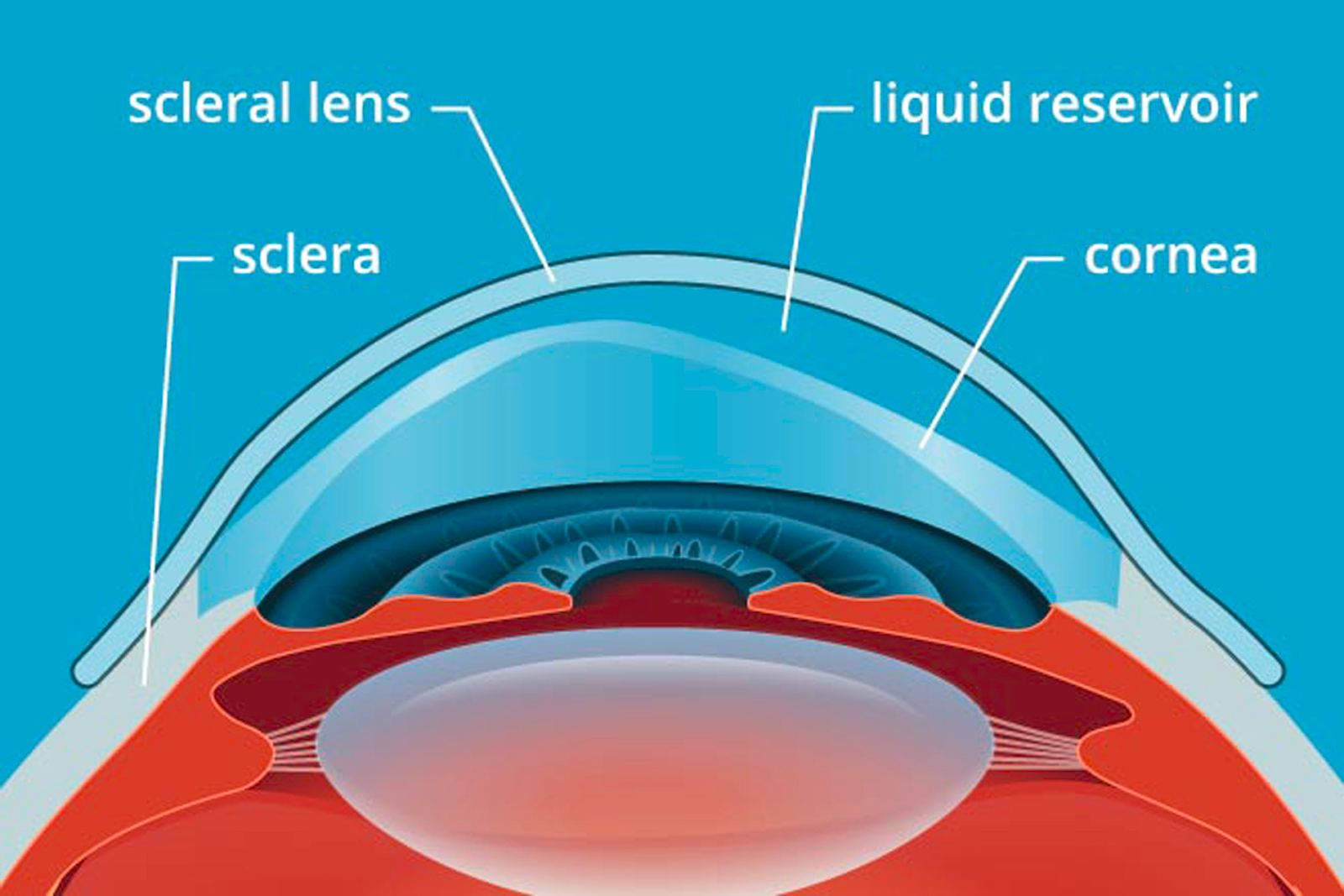
Another type of lens to correct vision for keratoconus is a scleral lens (Figure 2). This is a large lens that sits on the white part of the eye called sclera, therefore causing minimum discomfort to the eye, and it corrects vision because the lens vaults over the irregular cornea to mask its imperfection.

Figure 2. How scleral lens corrects vision in keratoconus. Image from https://visualeyesboca.com/scleral-lenses/

Back to my patient, I initially fitted him with special RGP lenses designed for keratoconus, but due to advanced bulging, these lenses were unstable on the eyes and often popped out when he moved his eyes around or blinked. I then fitted him with Jupiter scleral lenses. These are very simple and easy on the patients as they are a relatively small scleral lens and easier to insert for beginners. However, in his case, the fitting was not ideal because the edge of the cornea kept being pressed close to the back surface of the lens. This is not good in scleral lens fitting, as it may not leave enough space for the cornea to breathe. I then switched to BostonSight scleral lens design, which is larger and more easily vaults over the entire cornea. He was very happy about his vision, with the right eye seeing 20/25 and left eye seeing 20/20. He told me that he ‘hasn’t seen this well since 16’- that was probably when he started developing keratoconus. He’s now in his early 40s, and this was the first time he heard of keratoconus. 

Keratoconus is a condition that affects about 1 in 2,000 individuals. It usually starts in teenage years or early 20s, but can happen as early as 8 or 9 years of age. It tends to get progressively worse until stabilization in the mid 30s. There is often a family history, but not always. Both eyes tend to be affected, though one eye may be much worse than the other. We do not know the cause of the disease, but one modifiable risk factor is rubbing of eyes. So I always ask patients not to rub eyes. While it is progressing, an effective treatment called corneal cross linking can stabilize the cornea and halt the worsening of the condition. This procedure is typically done by a corneal specialist. Once cornea is stable, these special contact lenses such as RGPs or scleral lenses can often help patients to see what they used to be able to. Any keratoconus patient should have at least two types of eye doctors, one a corneal specialist, and one an optometrist who fits specialty contact lenses for keratoconus.

I feel like there are rocks in my eyes

by Juan Ding, OD, PhD

Today I had an urgent visit from an established patient. She’s in her early 50s, and has a medical history of high blood pressure, anxiety and depression. Regarding her eye history, she had narrow angles, which means she is at risk of developing a type of glaucoma (angle closure glaucoma), and for that she had laser peripheral iridotomy (LPI) before. This procedure allows fluid to communicate in the front chamber of the eye, preventing closure of the drainage system of the eye (the angle) thereby preventing high eye pressure from happening which can cause glaucoma. 

She was very anxious because since she started a new antidepressant, desvenlafaxine (Pristiq), 3 months ago, she started feeling like there were rocks in her eyes, blurry vision, more migraine and her blood pressure went up. Desvenlafaxine is a serotonin-norepinephrine reuptake inhibitor (SNRI), and it may cause blurry vision and angle closure glaucoma. She was very much aware of her narrow angles and worried that it’s causing glaucoma in her eyes. On her psychiatrist and pharmacist’s recommendation, she stopped the medication 2 days ago, but was now suffering from serotonin withdrawal syndrome. Her psychiatrist prescribed prozac as a transition drug, but wanted to make sure her eye pressure was not elevated. She had the medication in her car, and if the test was normal she would go and have her first dose. If not, she would not be able to start this new medication.

Fortunately, eye exam showed that she had normal eye pressure, and that her LPI was still working and her angles were open. So she was cleared to go on with another antidepressant.

But her eyes were dry, and this explained her sensation of ‘rocks’ in her eyes. She did try refresh artificial tears and felt it immediately helped her symptoms. I advised her that she could actually use these artificial tears regularly, up to 4 times daily, as long as she’s feeling the dry eye symptoms.

All too often, antidepressants and other medications cause dry eye. It’s not only uncomfortable, in some cases, causing extreme eye irritation in patients, who are anxious and depressed to begin with; but it can also cause blurry vision because of disrupted tear film. Anyone taking antidepressant is at risk of developing dry eye, and may try some OTC remedies first, like artificial tears, before visiting their eye doctors. Glaucoma is a much more rare side effect, but anyone with a history of narrow angles or glaucoma suspicion should be very careful- it’s best if they visit eye doctors routinely while on certain antidepressants. In severe cases of recalcitrant dry eye and/or glaucoma, an alternative medication may need to be considered.