
Skin Rash and Eye Health: Link to Uveitis Revealed

Juan Ding, OD, PhD

I look at eyes all day, and have to admit that I care less about anything else. But this case was a big help from another specialty which not only nailed the diagnosis but also saved a lot of $$$ and time on the expensive and lengthy tests that we so often have in the health care.

Case: visiting the eye doctor

A man in his mid 50s, Edward, we will call him, came into the office complaining about new floaters in the left eye for 1 week. This is a very common complaint, which I hear about almost daily.

If you read my previous posts, you would know that the most common cause of floaters are vitreous degeneration or detachment (link and also here) and the biggest worry would be that there was a retinal tear or detachment in the process (Refer to Figure 1 below for these structures: vitreous and retina).

He saw no flashes, and there was no injury to the eyes or the head. He had no pain and no visual changes.

The exam showed normal vision, normal eye pressure, and interestingly no vitreous detachment. However, there were some cells in the vitreous in the left eye (again refer to Figure 1 to see where the vitreous is in the eye). The retina appeared normal without any tear or detachment. A closer looked showed that there were even cells in anterior chamber, the front chamber of the eye (in contrast, the vitreous is the back chamber of the eye). 

Figure 1. The vitreous is a large space filled with a jelly inside the eye. In Edward’s case, this jelly now contains many inflammatory cells causing him to see floaters. Image from National Eye Institute [1].

So this was a form of uveitis, which is less common, but also can cause floaters, which I talked about in a previous case also (link). 

Uveitis is the inflammation of the colored layer of the eye, called uvea (Figure 1). Injuries can cause this inflammation, but so can infections, autoimmune diseases, cancer and sometimes no reason that we can find.

The question is, what is causing the uveitis?

More about this patient

I asked him if there was anything else going on besides the eyes? 

He said, ‘I have had a skin rash on my back before the floaters showed up. My dermatologist gave me a fungal cream but it’s not working and I am going back to see him next week.’

Otherwise he was in his usual health with no complaints.

Looking at his other office visits, I could see that he fought two cancers, once 10 years ago and once 5 years ago. Fortunately both were found in stage 1 and adequately treated.

He was HIV positive, but had normal CD4 values and was taking his anti-virals consistently. He was also being tested regularly on chlamydia and syphilis and negative in these in the last labs 4 months ago.

Based on this history, cancer is a concern. But HIV related etiologies are also possible. These both can cause uveitis. Further, inflammatory causes (non-cancer, non-infectious) are also possible. 

Cause of uveitis revealed by skin test

I promptly referred him to our uveitis specialist, who will run a battery of tests and imaging to figure out what is the cause.

However, it was his dermatologist that nailed the diagnosis and sent him for the definitive treatment.

Since the rash did not improve with medical treatment, his dermatologist performed a skin biopsy, which showed a very small bug (called spirochetes), the causative agent for the rash, and also the uveitis in the eye. These spirochetes are the microorganisms that cause syphilis, a sexually-transmitted disease that is sometimes found to be more prevalent in those with positive HIV. 

In this case, a simple skin biopsy saved him the trouble of a battery of tests and imaging procedures, which was the silver lining of his unfortunate symptoms. The treatment, IV penicillin, is usually quite effective.

Additional thoughts

In the end, this outcome might be the best it can be. Cancer in the eye, such as lymphoma, would be much more difficult to get rid of, not to mention possibility of death.

As an eye doctor, the most important thing is not to mis-diagnose this special form of uveitis as the good old vitreous detachment, even though vitreous degeneration or detachment is the horse, and uveitis is the zebra.

And syphilis, a great mimicker of all forms of uveitis, should always be tested, especially if the patient is at risk.

So if you have new floaters, please reach out to an eye doctor, because your retina may be at risk and it could be something else.

Learn more about uveitis from this reference below.

Reference

[1] Uveitis, National Eye Institute, https://www.nei.nih.gov/learn-about-eye-health/eye-conditions-and-diseases/uveitis
Gray floater in an elderly lady

Floaters can be so common, yet not all floaters are the same. Here is another example.

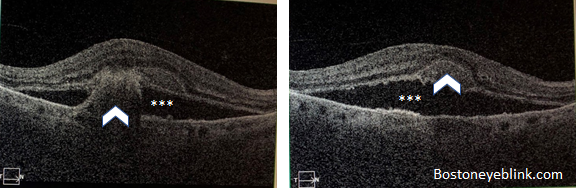
An 84 year old nice lady came for an urgent visit as she started noticing a greenish gray floater in the right eye for 1 week. She did not notice any flashes. Her right eye saw 20/400 with no improvement with pinhole (this usually means that vision cannot be improved with glasses). Her left eye was able to see 20/30.

It’s impressive that she had not had cataract surgery yet, and only had a moderate amount of cataract. One look at her macula in the right eye revealed why she saw this gray ‘floater’. There is a blob of blood there as shown in images below. 

Figure 1. New membrane (arrow head) and bleeding (***) in the macula of the right eye.

The other eye only had mild drusens in the macula, indicating early age-related macular degeneration.

So this may be a case of very asymmetrical presentation of AMD with the right eye affected by wet AMD with acute bleeding and vision loss, and left eye only affected by mild dry AMD.

I referred her to a retinal specialist for treatment.

See my other articles on “floaters” and related eye phenomena.

Annoying floaters, where do they come from? And what should you do about them?

Floaters in a young woman

Annoying floaters, where do they come from? And what should you do about them?

By Juan Ding, OD, PhD


I discussed previously floaters in a young woman, in her case (link here) the floaters came from inflammation of her eyes, which is not a common condition. Today I want to talk about the “common” or “regular” floaters that almost everyone has or will have.

I will start with two patients I saw yesterday. A 68 year old gentleman was on the airplane to Arizona to buy a house when he noticed a big floater following him everywhere in the right eye. It had been 5 days now and wouldn’t go away. His vision was the same, but he was very concerned and came to my walk-in clinic. One of my old patients, a 75 year old woman, who saw me 6 months ago for her annual eye exam, made an urgent appointment due to a similar complaint, big floater that suddenly showed up 3 days ago. As she’s an avid reader and knitter, this floater was quite annoying with her near work.

In both patients, I diagnosed them with posterior vitreous detachment (PVD). This is a common age-related eye condition, and happens in 60% of those in their 60s, and by age 90, 90% of people would have developed PVD. This may start in one eye and eventually the other eye would develop it also.

Vitreous is the big jelly occupying the bulk of our eyeball (Figure 1A. Please pardon my poor drawing techniques). On the backside of the vitreous is the critically important tissue- retina. Vitreous and retina are normally attached to each other. It provides structural support of the eyeball and nutrients to the retina. When we were born, the vitreous is typically a single solid piece. With age, the jelly gradually forms liquefied pockets here and there with protein strands floating around. This could happen at any age. So young people also may complain about seeing floaters, but typically small floaters that don’t interfere with vision. You may notice these in a bright uniform background such as the blue sky or a white computer screen. I personally have noticed my floaters since age 8.

As the vitreous becomes ‘weaker and weaker’, it will eventually lose its contact with the retina in multiple locations. The last location that this happens is usually close to the center of our vision, near the optic nerve. The moment that it pulls away from the optic nerve, it leaves a ring-shaped residue (Figure 1B), which floats around to annoy you. Since this is much larger, you will notice it more, and many people become very symptomatic and seek medical attention. Some people also experiences brief flashes of light lasting a second or two, and this is due to the vitreous pulling on the retina.

PVD

Figure 1. Normal vitreous and posterior vitreous detachment (PVD).  A. Normal vitreous is a jelly substance that attaches to the underlying retina. B. in PVD, the vitreous detaches from the optic nerve, forming a large floater.

The whole process is actually a normal age-related phenomenon, much like wrinkled skin or gray hair. However, one caveat- when the vitreous detaches, it sometimes pulls a piece of retina with it, causing a retinal tear and even retinal detachment. Fortunately this terrible incident happens in only 7% of those experiencing PVD 1, though some studies find this number to be 22% 2. Still, if you are experiencing a new floater, you should go to your eye doctor for a dilated eye exam immediately, because if you do have a retinal tear, it needs to be fixed within 24 hours.

Further, with a new PVD, the risk of retinal tear or detachment is still high within the next 4-6 weeks, so you should have a repeated dilated eye exam in about 4-6 weeks’ time even if no new symptoms come up. At any time, if you notice new floaters, flashes or light, or have a change in vision or losing a part of your visual field, you should seek immediate medical attention.

So what do you do with a PVD? If there is no retinal tear or detachment that come with it, you can rest assured. Your brain will eventually adapt to the floater and ignore it, though this may take quite a few months. Some very few people who are bothered by floaters and find it interfering with their normal life after even 6 months, a laser can be done to break up the big floater into smaller pieces so that you won’t notice them. Alternatively a vitrectomy surgery can be done to remove the vitreous; however, the surgery is invasive and carries the risk of having infection of the whole eye or developing new retinal detachment. You should talk to your retinal specialist if you are absolutely interested in removing the floaters.

If there is indeed a retinal tear discovered, a retinal specialist will treat this immediately with a laser to seal off the tear. Or if the tear is extensive, a surgery can be done to repair the detached retina.

Fortunately, both of my patients only had PVD and no retinal tear or detachment. I asked them to follow up with our retinal specialist in 4 weeks, and return to clinic immediately if new floaters, flashes or light, or change in vision happened to them.

Summary questions:

  • Can PVD cause retinal tear or retinal detachment?
    • Yes it may in a small subset of people. So always go to your eye doctor immediately if you notice new floaters or flashes of light.
  • How long will I see those annoying floaters?
    • Depends on individual, some may see them for up to 6 months.
  • Is there anything I can do if the floaters really bother me?
    • Please wait at least 6 months for your brain to ignore them. If they persist beyond that and bother you immensely, talk with a retinal specialist for laser or vitrectomy treatment. But be aware of risks of these treatments.

References


  1. Byer NE. Natural history of posterior vitreous detachment with early management as the premier line of defense against retinal detachment. Ophthalmology. Sep 1994;101(9):1503-1513; discussion 1513-1504.
  2. Uhr JH, Obeid A, Wibbelsman TD, et al. Delayed Retinal Breaks and Detachments after Acute Posterior Vitreous Detachment. Ophthalmology. Oct 23 2019.